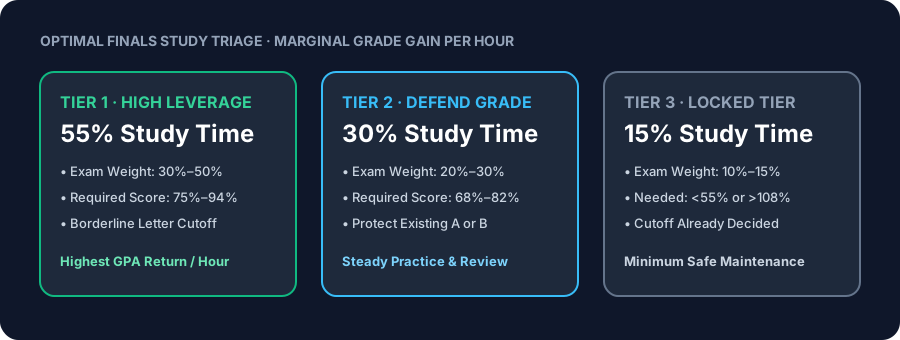
How Mathematical Study-Time Allocation Works
During finals week, time is a fixed budget. Instead of splitting 25 or 35 hours evenly across every course on your schedule, high-performing university students weight each class by its Final Exam Syllabus Percentage multiplied by an Urgency Factor (how close your current grade sits to a letter-grade or pass/fail boundary).
Why Exam Weight Multiplies Every Hour You Study
Suppose you have two upcoming three-hour exams on Thursday: Course A carries a 15% final exam weight while Course B carries a 45% final exam weight. Every 10 percentage points you improve on Course B's exam paper lifts your final transcript average by +4.50%—triple the +1.50% course gain from the exact same 10-point improvement in Course A.
Before building your revision calendar, audit every course in our Final Exam Target Calculator and Weighted Grade Calculator. Once you see the exact score needed for an A, B, C, or Pass, plug each exam's weight and urgency into the planner above to generate an instant hour-by-hour target.
Combining Credit Hours, Prerequisite Risk, and Diminishing Returns
Pure syllabus percentage is step one; transcript credit weight is step two. Moving a 4-credit Calculus or Organic Chemistry lecture from a B+ (3.3) to an A− (3.7) contributes four times as many GPA quality points as moving a 1-credit lab seminar by the same letter tier. You can verify the exact semester and cumulative effect inside our GPA Calculator.
At the same time, respect diminishing marginal returns: the first eight focused hours of active recall and past-exam practice in a neglected subject typically boost your projected exam score by 15 to 25 points, whereas hours twenty-five through thirty in an already mastered subject yield barely 2 or 3 extra points. Cap locked courses early and redeploy those hours to borderline cutoffs.
Recommended Finals Study Triage Matrix
| Course Situation | Typical Exam Weight | Urgency Multiplier | Share of Study Budget |
|---|---|---|---|
| At risk of D/F or failing major prerequisite | 25% – 50% | 2.0× (Critical) | 40% – 50% of total hours |
| Within 1–8 exam pts of next higher letter (B+ → A−) | 30% – 50% | 1.5× (High Leverage) | 30% – 40% of total hours |
| Protecting solid A or B (needs 68%–80% on final) | 20% – 30% | 1.0× (Standard Defense) | 15% – 25% of total hours |
| Grade mathematically locked (<50% needed, >105% next tier) | 10% – 15% | 0.5× (Maintenance) | 5% – 10% of total hours |
Study Planning & Grading Hub FAQ
How do I choose the Urgency Factor in the Study-Hour Planner?
Select 'High (1.5×)' when your required final exam score sits between 78% and 95% for an important cutoff or passing grade, 'Normal (1.0×)' when you need a comfortable 65%–77% to defend your current grade, and 'Low / Locked (0.5×)' when your letter grade is nearly guaranteed.
How many focused study hours per day is realistic during finals week?
Cognitive research consistently shows 6 to 8 hours of genuine active problem-solving (excluding passive re-reading and breaks) is the sustainable daily ceiling before memory consolidation drops sharply.
Should I study one subject per day or interleave two courses?
Interleaving two contrasting courses per day—for example, four hours of quantitative problem sets in the morning and three hours of conceptual synthesis in the afternoon—reduces mental fatigue and strengthens long-term retrieval.
Where do I calculate my exact normalized current grade before using this planner?
Use either Tab 2 on our Final Grade Calculator homepage or our dedicated Weighted Grade Calculator to combine homework, labs, quizzes, and midterms into an exact normalized standing.
What if an exam has a mandatory minimum pass score?
Never assign 'Low (0.5×)' urgency to a course with a mandatory 50% exam pass floor unless you are already scoring 80%+ on timed practice papers.
How do I see how finals week changes my cumulative college GPA?
Open our GPA Calculator, enter your projected semester letter grades alongside your prior cumulative GPA and completed credits, and inspect the live transcript projection.