Finals Week Grade Strategy — How to Allocate Study Hours by Exam Weight
Learn the mathematical triage method top students use to divide finals-week study time across weighted exams, borderline letter cutoffs, and credit hours.
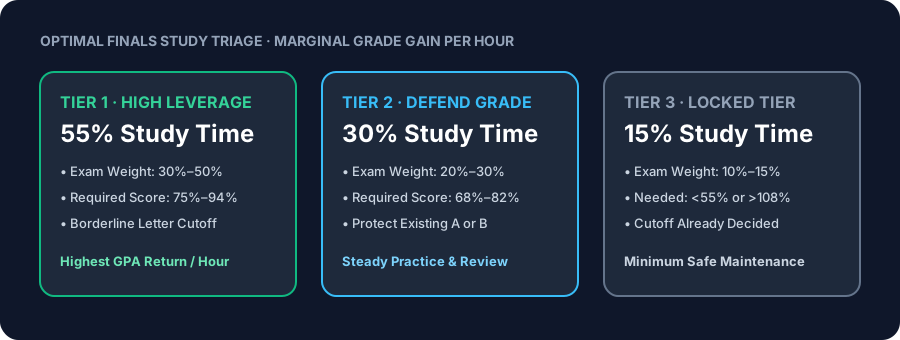
Why Equal Study Time Across All Classes Hurts Your Semester GPA
When finals week arrives with four or five exams compressed into five days, most students default to studying either their hardest subject or whichever test happens first on Monday morning. Mathematically, both instincts frequently waste your highest-return study hours.
Your semester GPA does not reward raw effort equally across courses. Instead, your transcript responds only to discrete letter-grade threshold crossings weighted by credit hours. Spending twelve hours raising an already locked 95.2% in a 15%-weight final to a 97.0% produces zero additional GPA points (4.00 stays 4.00). Meanwhile, shifting just six of those hours into a 4-credit lab course where you sit at 88.4% with a 35%-weight final can lift your course standing past 90.0% (B+ = 3.3 to A− = 3.7), adding +1.60 quality points to your transcript.
Before opening a single textbook, run every class through the Final Exam Target Calculator and record two numbers: your Required Exam Score for the next realistic cutoff and your Safety Score to avoid dropping to the tier below.
Step 1: Classify Every Exam Into Three Triage Buckets
Once you have computed your required final exam percentages (or 0–10 / 1.0–6.0 equivalents), sort your semester schedule into three strategic buckets:
- Tier 1 — High-Leverage Borderline Courses (Allocate 50%–60% of Study Time):
- Exam weight is 25% to 50% of the syllabus, AND your required final exam score to reach the next higher letter grade sits in the achievable 75% to 94% zone (or you need 72%+ to protect a fragile current grade).
- Every
+5%improvement on exam day moves your final course average by+1.25%to+2.50%, directly deciding your transcript letter.
- Tier 2 — Grade-Defense Courses (Allocate 25%–35% of Study Time):
- Exam weight is 20% to 30%, and you need between 65% and 80% on the final to keep your current
AorB, while jumping up a full tier would require103%+. - Your goal here is structured, mistake-free execution rather than perfectionism.
- Exam weight is 20% to 30%, and you need between 65% and 80% on the final to keep your current
- Tier 3 — Mathematically Locked Courses (Allocate 10%–15% Maintenance Time):
- Low-weight finals (10% to 15%) where maintaining your current letter requires only 42% on the exam and moving up requires 118%.
- Review core lecture summaries and past quizzes so you finish comfortably without cannibalizing Tier 1 preparation.
Real Case Study: Optimizing a 30-Hour Finals Study Budget
Consider Maya, a sophomore engineering student with 30 focused study hours left before four final exams totaling 15 credits. Here is what happens when she enters her Canvas grades into the Weighted Grade Calculator and Final Grade Calculator:
| Course (Credits) | Current Grade | Final Weight | Needed for A− (90%) | Needed to Keep B (83%) | Optimal Study Split |
|---|---|---|---|---|---|
| Calculus II (4 cr) | 87.5% (B+) | 35% | 94.6% (Reachable!) | 74.6% | 12 hrs (40%) |
| Physics I + Lab (4 cr) | 81.2% (B−) | 40% | 103.2% (Impossible) | 85.7% (Reachable!) | 10 hrs (33%) |
| Intro Psychology (4 cr) | 93.8% (A) | 20% | 74.8% (Keeps 90%+) | 39.8% | 5 hrs (17%) |
| Tech Writing (3 cr) | 94.5% (A) | 15% | 64.5% | 17.8% | 3 hrs (10%) |
Look at what the math uncovers immediately:
- Naive equal split (7.5 hours per class) would starve Calculus II and Physics I while over-investing 15 combined hours into Psychology and Tech Writing, where Maya already owns huge grade cushions.
- Weighted triage split (12h / 10h / 5h / 3h) concentrates 73% of her energy on the two 4-credit courses with 35%–40% finals where an extra 8–10 exam points lifts Calculus II to an
A−and Physics I to a solidB. Checking her Semester GPA Calculator, hitting both targets raises her term GPA from3.46to3.69—putting her onto the Dean’s List without studying a single extra hour!
Step 2: Check Hidden Syllabus Multipliers Before Finalizing Your Plan
Before locking your calendar, scan each syllabus PDF for three clauses that radically alter final exam leverage:
- Midterm Replacement (“Clobber”) Policy: Many Calculus, Chemistry, and Computer Science professors let your final exam percentage replace your lowest midterm score if the final is higher. If your lowest midterm was worth
20%and the final itself is worth30%, your final exam effectively carries 50% upward weight! Re-run that scenario in our Weighted Grade Calculator—a class that looked stuck at aB−may suddenly have a clear path to anA−. - Mandatory Exam Pass Floor: Some departments (especially in engineering, nursing, and European/Commonwealth universities) enforce a rule stating you must score at least
50%(or40%) on the final exam itself to pass the course, regardless of a95%homework average. Never walk into a Tier 3 exam completely unprepared if a pass floor applies. - Rounding Thresholds (
89.50%vs.90.00%): When a syllabus explicitly rounds to the nearest whole integer, always enter89.5(not90.0) as your Target Grade. On a25%final exam, that0.5%course difference lowers your required exam score by 2.0 full percentage points.
Frequently Asked Questions About Finals Study Strategy
How many days before finals should I calculate my target scores?
Run your initial audit 10 to 14 days before your first exam, as soon as your last midterm and major project grades post. That gives you enough runway to attend office hours for Tier 1 borderline courses rather than discovering an unexpected weight gap the night before the test.
Should I prioritize saving a D/F course over pushing a B+ to an A−?
Always prioritize passing first. Failing a course (0.0 GPA points, lost tuition credits, and prerequisite delays) inflicts far greater academic and financial damage than missing a plus/minus upgrade. Any course at risk of falling below passing (60% or 70% major requirement) automatically becomes Priority #1.
How do I study differently when I need 93% vs. when I need 75%?
When you only need 75% (Tier 2 Defense), focus on high-frequency core problem types that make up 80% of the exam points. When you need 93%+ (Tier 1 Stretch), core concepts are not enough—you must also drill edge-case derivations, multi-step synthesis problems, and common sign/unit traps under timed conditions.